
The Indian Space Research Organisation (Isro) on Thursday came out with the Indian Space Policy 2023 to promote greater private sector participation in the entire value chain of the space economy. According to the policy, Isro will encourage new-generation entities to participate in space exploration and human presence in outer space, including collaboration with domestic and international stakeholders. The policy also sets a road map for Isro to transition from manufacturing operational space systems to focus energies on research and development in advanced technologies.

Kerala on Monday became the first state to adopt a water budget in a bid to come up with a solution to water scarcity in certain regions there. The first phase of the project would cover 94 gram panchayats and 15 block panchayats. The Public Water Budget was released by Chief Minister Pinarayi Vijayan on Monday, along with the launch of the third phase of the Ini Njan Ozhukatte (Let me flow now) project, for the rehabilitation of irrigation networks in the Western Ghats.

'Silicon Valley people are generally used to layoffs.' 'Every person who has been in the industry for 15-20 years would have been laid off at least 3-4 times.' 'In India, we aren't used to that concept.' 'So when it came here, people were shocked.'

Automotive retail sales saw a 14 per cent rise in March on a year-on-year (YoY) basis, according to data released by the Federation of Automobile Dealers Associations (FADA). For the whole of financial year 2022-23 (FY23), sales grew 21 per cent YoY. For both March and the financial year, all categories, except for tractors, and including two-wheelers, three-wheelers, passenger vehicles (PVs), and commercial vehicles (CVs), posted double-digit growth. However, the total retail sales of 22.1 million for the financial year were still 12 per cent lower than the pre-Covid (FY20) level of 25 million, owing to an 18 per cent dip in the two-wheeler segment.

'The market has picked up for commercial vehicles. We are very close to pre-pandemic levels.'

On Easter, April 9, 10,000 BJP workers are being assigned to visit the houses of 100,000 Christian families. Plans are afoot to visit the homes of Muslims on Eid.

The country saw a massive year-on-year surge in the demand for electric vehicles, with retail sales of electric two-wheelers rising by 58 per cent, passenger vehicles by 130 per cent, three-wheelers by 82 per cent, and commercial vehicles by 171 per cent in March 2023, according to the data shared by the Federation of Automobile Dealers Associations (Fada). According to a report by JMK Research, the EV segment as a whole grew by 157 per cent during FY23, to 1,180,597 units, from 458,746 units a year ago. Overall, EV sales in March 2023 rose by 82 per cent from the March 2022 figure, the JMK report added.

At Prestige Polygon Towers in Chennai's Teynampet, hectic preparations are on for a mega global investors' meet under the aegis of Guidance Tamil Nadu (the state investment promotion agency) scheduled for January 2024. Asked about the key focus areas of the meet, the agency's managing director and chief executive officer, V Vishnu, said the state was betting big on electric mobility. This is no surprise, given that the state has signed electric vehicle (EV)-related memorandums of understanding (MoUs) with several companies in the recent past that may bring in investments worth around Rs 33,000 crore with the potential to create over 43,000 job opportunities.

'In FY23, PV sales are expected to end the year at a record 3.8 million units, up 26 per cent. In FY24, however, the industry is expecting 5-7 per cent volume growth'

Allowing 12-hour shifts for all and night-time work for women was meant to benefit software firms, but is said to have clinched Foxconn's Rs 80 billion investment.

According to Rajeev Jayadevan, co-chairman, national Indian Medical Association Covid Task Force, the current scenario qualifies as a wave.

South Indian Bank is likely to name a new managing director (MD) and chief executive officer (CEO) by May end, said the Thrissur-based lender on Wednesday. The bank's shares dipped some 14 per cent at one point after MD and CEO Murali Ramakrishnan said he will not apply for an extension when his tenure ends on September 30, citing personal reasons. The bank's board on Tuesday considered Ramakrishnan's request for not intending to continue on his post and appointed a search committee for his replacement.

Many of these companies have a waiting period from 6-18 months now, indicating a rise in demand.

Sridhar Vembu, Zoho Corp's chief executive officer (CEO), said on Tuesday a report that he financially abandoned his wife and son is "complete fiction". An article in Forbes magazine alleged Vembu, founder of the Indian SaaS company, had abandoned his wife Pramila Srinivasan and their special needs son in the US in 2020. Srinivasan and Vembu are fighting a divorce case in California.

'We would like to develop Andhra Pradesh into a logistics hub not only for India, but also for South Asia.'

Open order books in February breach 700,000; wait period for some models exceed a year.

'It is Dhoni, Fleming and the support staff who decide on cricket.' 'The fans expect CSK to do well, and with Dhoni at the helm, CSK is capable of it.'

India is now much ahead of other large railway networks in the world in terms of electrification -- with the US at just 1 per cent, China at 72 per cent and Europe at 60 per cent.

With just a month left in this financial year, electric two-wheeler sales, so far, are at just 62 per cent of the ambitious target of 1 million units set for 2022-23 by the NITI Aayog. According to VAHAN data, compiled by the Society of Manufacturers of Electric Vehicles (SMEV), 620,006 units of electric two-wheelers were sold across the country in FY23 until February 21. Though the industry may miss the 1-million target, sales in FY23 are already up 146 per cent from 249,621 units sold in FY22.
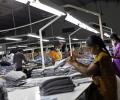
Following a gap of several months, global brands like Walmart have started lifting orders from Tiruppur's garment makers, leading to growth in knitwear exports in January after five months. Knitwear exports from Tiruppur increased 1.5 per cent in dollar terms and 11.6 per cent in rupee terms in January. According to the Tiruppur Exporters' Association (TEA), global majors have started placing more orders from the region.
 © 2026 Rediff.com - Advertise with us - Disclaimer - Privacy Policy - Sitemap - Feedback - About us - Terms of use - Grievances